
General Irvin McDowell's Inevitable Failure: McDowell and the First Battle of Bull Run
Everything worked against the Union Army of Northeastern Virginia and its commander.
Military history has a way of repeating itself. Parallels run from conflict to conflict.
The inevitability of early command failures is almost a constant throughout history. Generals earmarked during peacetime for wartime leadership fail. Plenty of times, these leaders have years of command experience under their belts, sometimes wartime experience at that. But time and time again, some of these bright stars get relegated to the background of history.
Just a few examples are: George B. McClellan, John C. Fremont, Joseph E. Johnston, Husband E. Kimmel, Helmuth von Moltke, Sir John French, Sir Ian Hamilton, and the list goes on.
Someone who is often forgotten, once a potential star in the United States Army, General Irvin McDowell is one of those buried in the history of the Civil War.
McDowell has been relatively forgotten by history.
There were no biographies written of the general until 2023.
In all reality, history has been somewhat unfair to Irvin McDowell. Along with many of the Civil War’s more infamous figures, men like George McClellan, Ambrose Burnside, McDowell, and others, they are forced to shoulder a lot of the blame.
Once at a Christmas-themed Civil War reenactment, a group of re-enactors played the part of Union soldiers in limbo on the Rappahannock outside Fredericksburg, Christmas 1862. I made a comment about Burnside likely being over-vilified for his role at Fredericksburg. One re-enactor, almost hostile, yelled at me, “It was his fault!”
Was it?
I know McDowell is the star of this show, but I think about that a lot. Burnside was given a command he never wanted, of a force larger than any organized in American history to that point, to fight on an unprecedented scale, suffering from major logistical failures, and being pushed constantly by Washington to attack! Results were all that mattered, as long as it crushed the rascally rebels into dust.
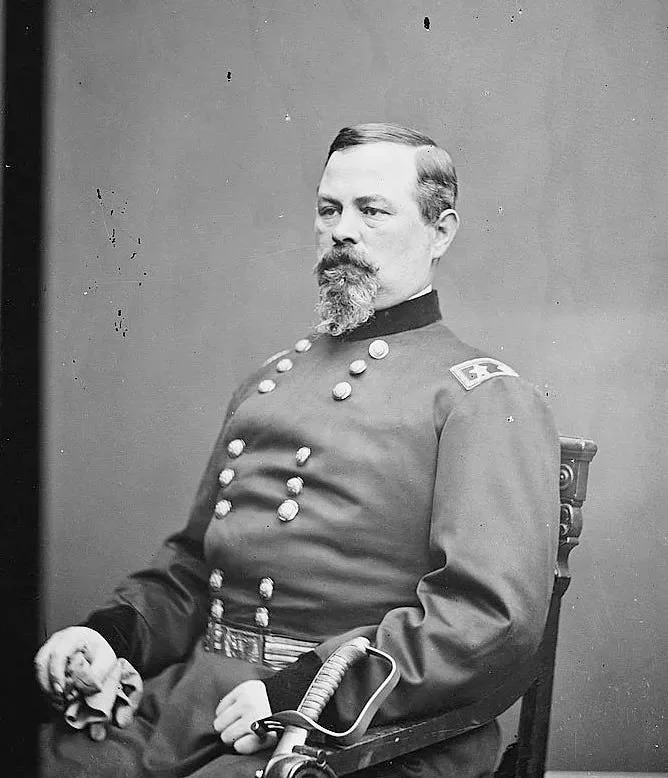
Major General Irvin McDowell
McDowell is another one of these figures who many popular opinions circle back to the First Bull Run, that embarrassing retreat back to Washington, somehow being his fault. McDowell didn’t do himself any favors after the Second Bull Run battle, but that’s a discussion for a different day.
Irvin McDowell was a soldier who did everything the right way before 1861. He graduated from the United States Military Academy in 1838, then taught tactics at his alma mater from 1841 to 1845. He became a staff officer during the Mexican-American War, serving with enough distinction while under fire to get a brevet (temporary) commission to the rank of major. In the quagmire of the antebellum US Army, McDowell made his way up to work as a prominent staff officer, becoming known for logistical capabilities.
Typical of armies of the 19th century, McDowell used military patronage for his ride to the top. He was close friends with America’s great war hero, Winfield Scott, Commanding General of the United States Army through the first year of the Civil War. Until his promotion to command of the Army of Northeastern Virginia, where their relationship soured.
McDowell was thrust into the spotlight in May 1861, just a month into the Civil War. Just like his military patronage, he benefited from the help of his friend Salmon P. Chase, Lincoln’s Treasury Secretary, to land command of the Army of Northeastern Virginia. It was the Union’s largest army on the eve of Bull Run in July 1861. The army was selected to have the fateful duty of punching its way to Richmond, the capital of the Confederacy.
Was Failure Inevitable?
McDowell’s expectations for his army, and those placed on him, were probably too high. The newly promoted general was commanding 35,000 men, which was the largest single American military force ever assembled prior to the Civil War. Now, in comparison to the war’s later years, that sounds small, but nobody had ever commanded a unit so large in the field out of the entire US officer corps.
McDowell’s Army of Northeastern Virginia was meant to make quick work of the rebellion, crippling their hopes of standing up to the might of the US government, but it wasn’t a group of US regulars. In fact, at Bull Run, only one battalion of his army was made up of old army regulars. The rest were a concoction of 90-day volunteers who had answered Lincoln’s call for a swift end to the Confederacy. There were some newly arrived units made up of volunteers who’d signed three-year papers, but just like their 90-day counterparts, they were hardly a veteran force.
The body of volunteers had little time to drill, train, and learn the nuances of tactical maneuvers properly. Certainly not to the liking of a lifetime staff officer and former tactical instructor at West Point like McDowell. The general knew his army wasn’t ready, but the clock was ticking.
Political pressure was rising.
The Civil War was heavily influenced by politics. It inundated everything, including wartime funding, support, and the reasons behind various actions. Lincoln was constantly under pressure to produce something resembling a victory as a way to save face politically. Early on, the fervor for the war boomed, but the public wouldn’t stand by idly for long without some type of action, a show of strength. McDowell no doubt felt the pressure coming from the top.
The civilian sphere of influence within the Union put further pressure on the Union Army to act. Newspapers printed demands; it was time to act. The move was obvious. They had to press on to Richmond and take the Confederate capital before anything of consequence could be done there.
Mounting pressure required a move.
McDowell commanded the largest army on US soil; facing ahead towards the Confederate capital, the road led through Manassas Junction. His plan to move on towards the building rebel defenses was obvious. The question was: When?
In late June, he presented his plan to the War Department and the US government. He was going to put a complicated plan into place to take the key junction at Manassas.
The overall US commander, Winfield Scott, had a different view of the war. He wanted a larger, better-trained force to choke off the Confederacy in a more coordinated effort, which is known as his famous “Anaconda Plan.” It wasn’t something Washington or many of the radical Unionists would stand for in the early days of the war. The irritating rebellion needed to be staunched as quickly as possible, and that required action. It’s why the War Department readily accepted McDowell’s plan to attack the Confederate force building up at Manassas Junction, where men under P.G.T. Beauregard had built a solid line of defenses.
McDowell’s plan first called for a Union force to pin down Confederate General Joseph Johnston’s army up in the Shenandoah Valley. Why? Because Manassas was a crucial rail junction for supplies and men. If Johnston used the railways to bring reinforcements to Beauregard, they could sweep in and surprise McDowell’s army. With Johnston busy in the Shenandoah, McDowell could bring up his army, turn Beauregard’s flank with superior numbers, and score a major victory for the Union.
Against the advice of Winfield Scott, McDowell’s plan to attack was approved. Scott didn’t like the idea of uncoordinated piecemeal attacks that didn’t apply to some overarching strategy.
Regardless of his protests and his growing dislike of McDowell, the government entities thought it was time to move.
Washington needed something to happen, and now. Manassas Junction was just 30 miles from DC. Time was running out, as many of the volunteers were already nearing the end of their term. It’s likely Lincoln and his cabinet dreaded the idea of calling for more volunteers, especially those who would be forced to commit several years to the war effort. With the greater numbers, it was time to strike hard and fast. Washington approved.
What went wrong?
Well, just about everything. It all began with McDowell’s long military career.
Irvin McDowell theoretically should have been a great fit for commanding this operation. There was one major problem, though. He’d never held a field command, let alone commanded a force the size of his army. It was an issue that plagued both Civil War armies. Nobody had the experience of leading forces of such magnitude.
McDowell, like many Civil War generals and officers, was a West Pointer. He was a professional. West Point was the premier military college in the United States. The middle of the 19th-century saw a rise in the “professional” US army officer, especially those who graduated from West Point after gaining one of the few coveted spots, but they were hardly prepared for the Civil War.
US Military Academy grads spent most of their time learning mathematics, engineering, with tactics being somewhat of a secondary focus. There was nothing to prepare them for leading massive armies of Civil War scale in the field. Although McDowell was a tactics instructor at West Point, he had never experienced the realities of seeing these tactics through in combat via his leadership.
To McDowell, like many West Point graduates who went on to serve in the Civil War, they entered the war believing that military tactics worked like a sort of mathematical formula. There wasn’t room for obstacles in the planning. Things should move in coordination, like on a chessboard, where success is determined by strategy versus calculating for hypotheticals, or giving some lower-level commanders the autonomy to move or adapt depending on the realities of the battlefield.
McDowell applied a professional lens to planning his operation at Bull Run and made it far too complicated for his volunteer army to execute.
He wasn’t leading hardened, disciplined regulars. Instead, he was given an army of volunteers, many of whom were nearing the end of their contracts and had been civilians just months before. Most of his lower-ranking officers in the field were as green as the troops they commanded, but McDowell still planned his attack as if he were leading grizzled veterans.
It makes sense coming from a general who’d spent decades in the army, teaching tactics and working as a staff officer.
Historians have been at least relatively positive, if not impressed, by McDowell’s plan at Bull Run. It called for flanking maneuvers, feints, and likely could have worked had his army been given a little more time to train and prepare, but time was of the essence when much of his army was ready to head home.
The inexperience of his army slowed his plans.
The General’s initial plan for Bull Run called for an attack on July 9, 1861, but his green army wasn’t ready to move until July 16. It was fateful timing. In the Shenandoah, a Union Army of roughly 18,000 men, under the command of Major General Robert Patterson, was meant to hold Confederate General Joseph Johnston’s 10,000 men at bay. Patterson, a War of 1812 veteran, was duped into believing that a small contingent under the command of Confederate Colonel J. E. B. Stuart was engaged and represented Johnston’s entire force. Meanwhile, on July 16, Johnston’s army slipped away by rail via Winchester, Virginia, just in time to reinforce Beauregard at Bull Run.
Manassas Junction was just 30 miles from Washington D.C., but the march to reach the Confederate enemy took four days for many of McDowell’s units, and five for some. The greenness of McDowell’s army showed here, as in the later years of the Civil War units could march up to 20 miles a day.
When McDowell finally committed his army on July 21, he massed most of his force on the Confederate left flank. Coincidentally, Beauregard anticipated hitting McDowell on his right and sent most of his forces away from the Union attack. There was an actual opportunity to break the Confederate lines, but the inexperience of McDowell’s army and the general himself came into play.
The sweep to hit the Confederate left at dawn forced a night march of a dozen miles that stalled the Union army. The “surprise” dawn attack didn’t kick off until 10:30 am on July 21. The problem with a pre-dawn attack going off in daylight is that the enemy has more potential to spot you, and this is precisely what happened.
McDowell moved a huge portion of his army on a sweep to the north, to swing south and crush the Confederate’s weakened left flank. To distract the rebels on the left, he had some of his forces demonstrate their intentions to attack with a small artillery bombardment near the Confederate center. It could have worked. The Confederate left, held by Shanks Evans, was distracted by this ruse. Meanwhile, a Confederate captain who would later have a much greater role in the war, Edward Porter Alexander, spotted flashing bayonets and equipment to the north where the Union flankers were sweeping down. He signaled using flags.
“Look out for your left! You are turned!”
This was the first sign of things to come. Evans was grossly outnumbered, but knew if he delayed, the Confederates could bring up reinforcements. They did. Confederate forces from the right flank started to shift left, including Thomas “Stonewall” Jackson’s brigade, which was part of Johnston’s force arrived just in time.
The clash began at Matthew’s Hill.
This article is hardly meant to be a deep tactical breakdown of what happened at the First Battle of Bull Run. Evans was reinforced, holding out long enough to delay McDowell’s flanking move. While fighting occurred at Matthews Hill, the Confederate reinforcements made their way to the high ground at Henry Hill. The Confederates at Matthews Hill eventually broke, retreating back towards Henry Hill. It looked like a rout. McDowell took the day.
McDowell’s Baffling Decisions
But then he did something unthinkable. Nobody really knows why. He delayed. For two hours he didn’t move; meanwhile, the Confederates reinforced Henry Hill.
McDowell continued to baffle historians with some of his next moves. Still having numerical superiority, he should have sent the mass of his army in to sweep the Confederates off Henry Hill, but he didn’t. Instead, he sought to micromanage the battle, sending in one brigade at a time without coordination. All afternoon he sent brigades in piecemeal, a full-frontal assault against an entrenched enemy.
Probably even more bewildering were the decisions he made concerning his artillery. McDowell had two batteries of rifled cannons, capable of firing accurately for up to two miles. Instead of using this to his advantage, McDowell brought his cannons in for close infantry support.
Now, as an aside, there has been some historical analysis on the use of rifled cannons during the Civil War. It took some time to learn the proper way to use them. Before the Civil War, most cannons were smoothbore and used as close infantry support guns because their short range and inaccurate fire required closer contact with the enemy. So, perhaps, McDowell commanding the first major battle of the Civil War had an old-school mentality where he didn’t grasp the concept of long-range fire.
McDowell brought his guns up for close-range support, within the firing range of Confederate smoothbore cannons explicitly designed for close-range firing. Placing his guns on either side of the Henry House at the hilltop, he put them in a dangerous position. These modern guns were poorly equipped to offer any close-range support. This was one of his greatest mistakes on July 21.
Fighting raged and casualties began to pile up.
The Union batteries under the command of James Ricketts and Charles Griffin were perilously left out in the open with no infantry support. McDowell’s Artillery Chief, Major William Barry, assured the hesitant artillery officers that infantry support was on the way.
From the woods surrounding Henry Hill, an infantry regiment wearing blue uniforms emerged. Captain Griffin loaded canister into his guns to bombard the emerging unit, but Major Barry ordered him to hold fire. He believed they were Union infantry coming up for support.
They weren’t.
Around 2:30, men of Stonewall Jackson’s brigade, the 33rd Virginia, wearing blue uniforms, moved quickly and at close range poured fire into the Union battery. The guns were lost.
McDowell ordered more piecemeal attacks to recapture the guns. By 3:30, the attempts were deemed futile. Too many Confederate reinforcements were moving into the area. This is where the Union morale and resolution famously broke, sending men rushing back to Washington.
McDowell Failed. But was it all his fault?
There is much to be examined here, but being the first engagement, it’s hard to fully blame McDowell. Notice I said fully blame. He is certainly a key ingredient in the failure.
He was a career soldier, never commanding men in the field, commanding the largest army in US history to date. His soldiers were green, mostly made up of poorly disciplined, novice volunteers, who were commanded by men of equal experience.
McDowell’s testimony before the Joint Committee on the Conduct of the War showed his feelings about the performance of his green army. He ripped into the weak officers and blamed them for poor discipline that ultimately led to their “stampede” from the field.
In Washington and other parts of the US, there were ardent demands for an attack. His moves were printed in newspapers, hardly giving him the element of surprise or a shroud of mystery as to his objective.
He felt compelled to micromanage. His career as a staff officer really only prepared him for this micromanagement. The general felt the need to do everything, from scouting to ordering assaults. A British war correspondent for The Times, William Howard Russell wrote of McDowell’s complete lack of a staff and the general being forced to perform his own field reconnaissance. (My Diary North & South, pg 20)
All of this culminated from the pressure placed on him and his army to make a move, a crushing assault against the Confederates. The men weren’t ready, and he was surrounded by many who didn’t know what they were doing, himself included, but he was the true professional among the bunch.
I know I keep referring to the inexperience of his army, but it played a role in the entire campaign. It took them an extremely long time to march the thirty miles toward the junction. The plan to pin down Johnston in the Shenandoah failed, so by the time he arrived to engage the enemy, Johnston’s reinforcements had arrived. They were slow in getting to the point of attack, arriving in daylight where they were spotted by the Confederates. The defenders had time to turn their attention to his main assault and ultimately delay long enough to bring up more units.
This is by no means an attempt to excuse McDowell. He made some egregious tactical mistakes. His delay in pressing on after the Confederate retreat at Matthews Hill gave the Confederates time to regroup, and his decision to move his artillery forward as close support cost him his guns and the battle.
In totality, McDowell’s lack of field command experience, along with all the other factors above, resulted in disaster. His legacy was one tied to military failure, despite the respectability of his pre-war career.
McDowell was promptly replaced after Bull Run. His army was turned into the Army of the Potomac. Recognizing the inevitability of a lengthy war, the Union Army promoted a man who was better suited to whip their largest army into shape, promoting General George B. McClellan in August of 1862. McDowell was relegated to a division, then corps commander.
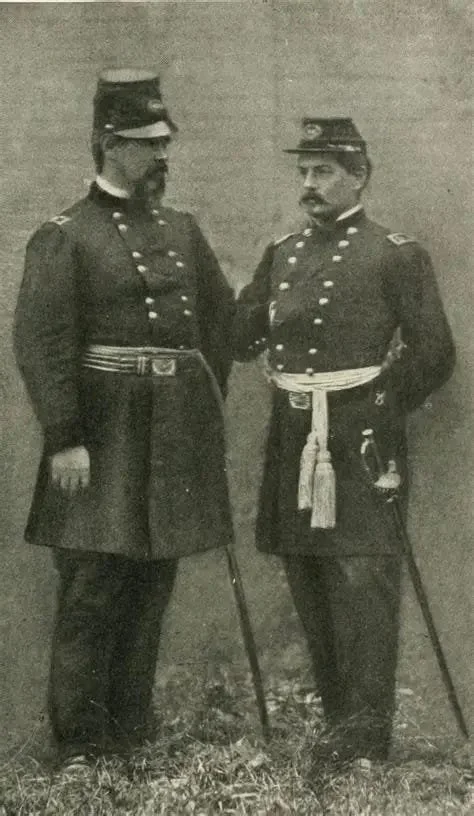
Generals Irvin McDowell (left) and George B. McClellan (right)
McDowell did his legacy few favors with his actions at Second Bull Run in August 1862, ultimately costing him meaningful command for the duration of the war. I’ll discuss next week.
McDowell was forgotten by history. His career was seen as a failure. In reality, McDowell was a victim of circumstance. What would his career have looked like had he been given time to gain combat experience for a few years before holding a major command? Or, what if McDowell had been used in a way that highlighted his experience and strengths. He would have been far more useful as an experienced staff officer, quartermaster, or advisor.
He fell in alongside dozens of professional officers on both sides who were not able to lead forces as large as his army in July, 1861.
This is hardly meant to be an outright defense of McDowell, rather it should be used as a way to study military history and understand the parallels between him and so many others throughout history. The numerous highly regarded military officers who fall victim to being the first to hold major command throughout history’s major wars.