
The Hellish Battle of the St. Eloi Craters: Part II
The Canadian 2nd Division’s Baptism of Fire, April, 1916.
The rookie Canadian units moved over the alien landscape in darkness. The sounds of men punctuated the quiet blackness, trying to cover their movements. Occasionally, there was a curse, or the sound of a man sliding down the clay-slicked ground. Beyond the British-Canadian trench lines, the Germans were watching, peering through the darkness. German rifle fire echoed, followed by a faint whizzing. Another was followed only by the explosion of mud somewhere beyond the men moving into the line.
As the Canadians shuffled in, completely lost in darkness, to relieve their British allies, the Germans dropped in the heavy stuff. Beyond the void, there was a thump, followed by the crashing scream of a shell that landed somewhere near the travelling men. The world exploded, lighting their pathway as if it were daylight. The men hauling ammunition, rifles, entrenching equipment, and medical supplies scattered, diving down into the mud that sucked around them. Geysers of mud, clay, and debris rained down, covering rifles, machine guns, and bullets with a layer of thick, sticky mud. There were curses, whimpers of terror, and the sound of officers and NCOs hissing orders, getting the men back to their feet.
They were the Canadian 6th Brigade. As part of the Canadian 2nd Division, they were newcomers to the war in Europe. Their veteran brethren, the Canadian 1st Division, had already endured months of hell, living in the quagmire, facing the constant threat of artillery, and had even fallen victim to some of World War One’s first gas attacks. These men of the 6th Brigade were heading into get their first taste of real combat, outside of occupying some trench lines along the front, these men were brand new to war. They were walking into the worst imaginable situation.
The “lines” the units were moving to occupy could hardly be referred to as trenches. A week earlier, on March 27, 1916, the British went on the offensive to capture a piece of high ground called “the Mound.” This key land feature of the Ypres Front had given the Germans a nice observation point to see down into British lines. Only thirty feet high and stretching roughly half an acre, this spoil heap might as well have been a mountain in this landscape.
To oust the German defenders from the Mound, the British first kicked off their attack with a surprise. From deep within the earth below the Mound, six mines were detonated, obliterating the German defenses and completely catching the Germans by surprise.
Blowing the mines opened the door for the British to finally capture the Mound, but they turned the world around them into a devastated mess. The British moved around seven deep craters blown into the ground, trying to find their way through trench lines that no longer existed. Men were lost in the fray, trying to consolidate their positions, but it was impossible. The lack of proper trench lines forced British officers to patch their lines up with whatever men they could, leaving massive gaps in their front lines. Machine gun crews were left to fight in isolated positions.
For days it rained. The ground where the Mound sat was a combination of mud and clay that made the ground sticky, swallowing men up to their knees. To make matters worse, the ground didn’t drain; instead, every hole filled with water, standing like a reservoir. Without trenches, faced with the constant rain and the collapse of any attempt at digging trenches, the British soldiers dug shallow holes, living in them as they were bombarded by constant cold rain and German artillery.
For a week, the British did what they could to hold on. They had captured the Mound, or what was left of it, but keeping it was another story. Exhausted soldiers tried to dig into the sticky ground, but the constant German artillery bombardments stalled any progress. Artillery attacks were joined by German counterattacks and bombing raids, sent to push the British from the newly captured positions.
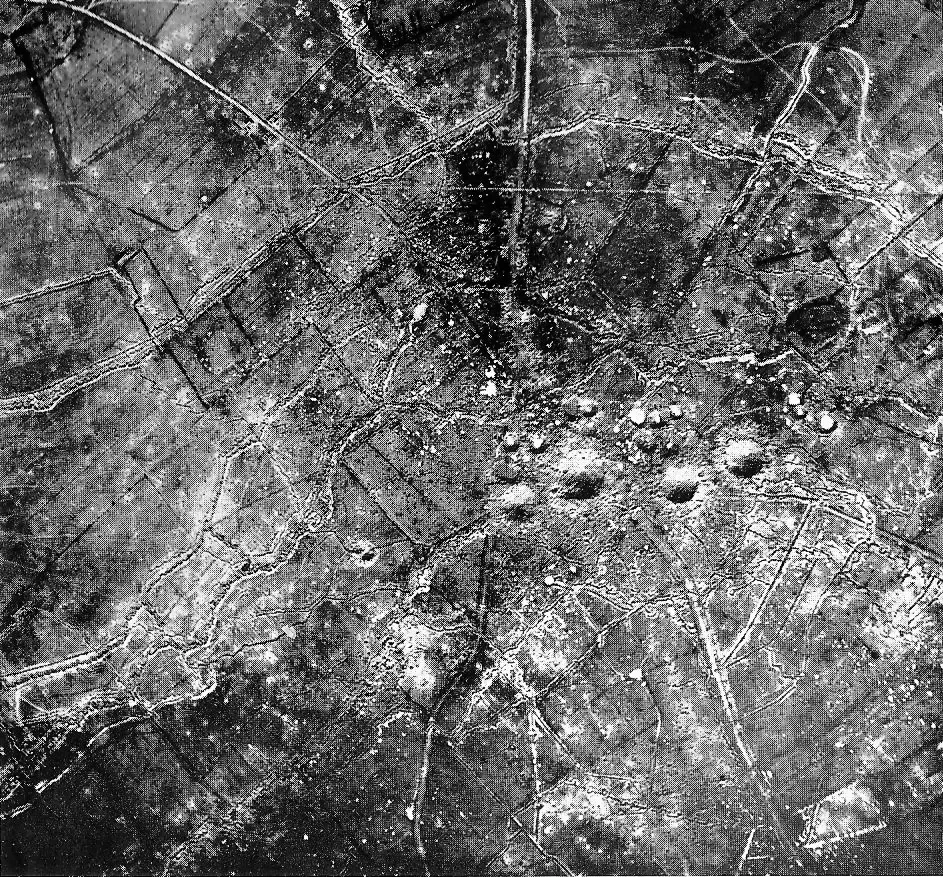
Aerial Photo of the St. Eloi Craters
Canadians Move Into the Line
The British situation was dire. They couldn’t hold on to the ground around the St. Eloi Craters anymore. They needed relief. For as long as they could, the British clung to their thin front lines, taking constant artillery fire and German counterattacks. There was virtually no front line to speak of, and the defenders were forced to hunker down in muddy ditches while they waited for the inevitable German artillery fire and soldiers to come push them off the ground.
Brigadier General H.D.B. Ketchen’s 6th Canadian Brigade was picked to relieve the British. It was a last-minute order. No preparation, no scouting. They had none of it as they were going to see their first major action of the First World War.
On the night of April 3/4, 1916, the eager, fresh Canadian soldiers of the 27th and 31st battalions made their way towards the front. Beyond the ground they walked, they could see the German artillery shells lighting up the horizon, followed by the hostile rumble of explosions. That was where they were headed.
Spending several months manning the trenches around Ypres, they expected to make their way forward, using the cover of communication trenches to shield them from the exploding shells, but when they got to the front, there were no trenches to guide them in.
Exhausted, mud-covered, tattered-looking British scouts met them at the edge of the cratered land to guide them in. They followed along, stepping into a world that looked more like a foreign planet, or some circle of hell, than any earthly place. The sludge that had been battered by constant rain swallowed their boots. They strained hard, fighting with burning muscles to lift their legs one at a time.
Coming the other way, they saw a scraggly bunch of men heading toward them, hunched with exhaustion. As they passed by, the newcomers looked into faces that were haunted by days without sleep, filled with constant fear and trauma. One Canadian soldier, Private Donald Fraser of the 31st Battalion, called out, “Cheer up! Don’t be downhearted!”
A gaunt voice called back, “You’ll be downhearted when you see what’s up there; I have lost my best chums.”
The landscape had no major features to guide them, aside from the massive craters. When they looked down into them, they saw the deep, water-filled holes. Floating in them were decomposing bodies, battered equipment, and the stench of death filled the air.
Their guides, despite spending several days in this foreign place, couldn’t find their way. Everything looked the same. To make their transition even more confusing, there was a last-minute change in their orders. The 27th and 31st would swap places, with the 27th occupying the forward-most positions in front of Craters 1 through 5 on the right and the 31st taking positions on their left, near Craters 6 and 7.
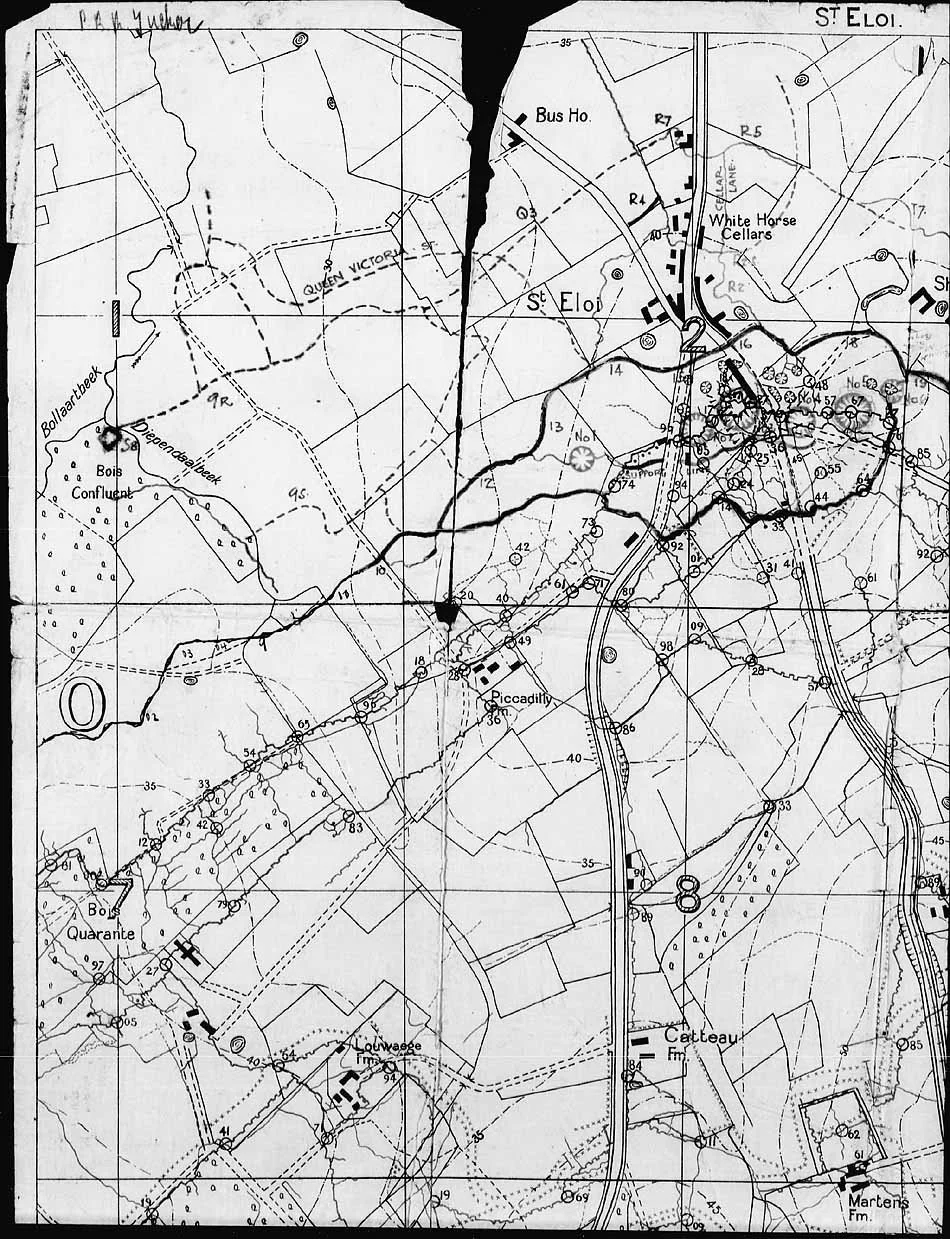
This map comes from the Library and Archives of Canada, found in the War Diary of the 31s Canadian Battalion. This map shows the layout of the Canadian trenches in relation to the Craters.
To the Front
When the Canadians reached the front during the early morning hours of April 4, they found themselves with little in the way of protection.
Company “C,” of the 27th Canadian Battalion walked into an area where “The Trenches were hardly distinguishable and were full of water which came over our gum books and we had to halt several times to make sure of our way.” (27th Battalion War Diary, Appendix IV, Narrative of C Company)
“C” Company’s War Diary also states:
“There was very little trench except for about 20 yards at Point 44.”
The story of “C” Company was a good example of the rest of the Battalion’s St. Eloi experience. Company “B” Commanding Officer H.S. Edwards put his men to work fortifying the horrendous trenches they occupied. Men frantically filled sandbags in the dark as the Germans fired artillery on the Canadian positions.
The condition of the trenches was a shock even to the higher-ups in the 6th Canadian Brigade. The official war diary of the brigade states:
“Brigade Major went round new line and reported it in very bad shape. Captured line was waist high in water and movements of our men considerably hampered by dead and wounded of British Units.”
The entire experience of St. Eloi is unimaginable. Try to put yourself in the shoes of these green, rookie soldiers, coming to the front for the first time. They were probably racked by anxiety, but before that moment there was probably eagerness. It was finally their moment. For over a year they waited to get into the fight, ready to prove their worth and bravery under enemy fire. The night before heading out, there were likely men, cocky, bragging, they were going to run in, killing Huns in droves.
After all that, the soldiers came into the fight, walking over a landscape that was a scene of horrific devastation. The scouts leading them were exhausted, lost, while they passed by British veterans, combat veterans who’d spent months, maybe years, out there in the heat of battle. These veterans are hollow-eyed, sad, exhausted, ragged, mud-covered, blood-spattered.
When they finally found their lines, they didn’t walk into a deeply dug trench, with high parapets and sandbagged walls. No, they walked into shallow ditches. For some of them, they had nothing more than water-filled shell holes to cover them from the torrent of German artillery they were about to face. They had to walk in water up to their knees and waists in some spots, slogging past the bloated, mangled bodies of dead British and German troops. Some made their way to the trench line to find the walls filled with Germans who were buried alive when the mines were exploded back in March.
With no true trenches to protect his men, Lt. Colonel Irvine Snider and his company commanders had to spread his men out, placing them along the line where they could.
The previous British occupants had set up several fortified machine gun positions, holding gaps of the line where they couldn’t find the bodies to plug the holes. The 27th Battalion officers, specifically the Machine-Gun section, came into the line expecting at least four machine guns emplaced for them to take over. Two of the British teams were to hold on until they could be relieved by the Canadians, but as Machine-Gun Section Commander Lt. T.H. Webster arrived at HQ around St. Eloi, he was shocked to see two tired British crews walking in. There was now only one working Lewis gun along the main line of Canadian defenses, and he quickly sent a team along to man the gun.
April 4th was spent furiously bolstering their trench lines, but the work would be futile. Later in the morning, around 11 am on April 4th, the Germans unleashed a furious bombardment, keeping up heavy fire throughout most of the day. Work done to shore up their trenches was obliterated by the fire.
Artillery pummeled the rookie 27th Battalion soldiers of Companies A. Soldiers had to hug the muddy ground, praying, hoping that the shells would miss them as the world exploded around them. Men were buried by splashing mud and debris. Some men were hit and vaporized by the impact of the German shells. The enemy had a perfect view of a large section of the Canadian trenches, easily directing their artillery. They were in a perfect position for their snipers to take shots at soldiers trying to repair trenches.
What ensued over two days in the front lines for the 27th was devastating. Company B of the 27th Battalion estimated they took 50% casualties by the end of April 4th. Machine gun positions were knocked out. Men had nowhere to go.
During the day, the 27th Battalion ordered their men back to safer positions in the support trenches, knowing the Germans would pound their positions all day.
Company B was so thinned out by the German bombardments they needed relief after just one day. C Company moved into the line, occupying the positions formerly held by B Company, but the defense was futile.
For the duration of the St. Eloi operations, the 27th wasn’t alone. Holding the right flank, next to the string of craters, the 31st Canadian Battalion joined the fight. Like their brethren in the 27th, they were subjected to torrential artillery fire.
Major Daly of the 31st Battalion wrote from their time entering the line that they were a “continuous bombardment [and it] lasted for 17 1/2 hours, breaking up all the communication trenches from point 19 s.s. right up to the old front line, and made it absolutely impossible to go by daylight there being no cover whatever.”
Appendix No.16, 31st Canadian Battalion, War Diary, 1916.
The situation along the front for the 31st and 27th had a similar narrative. For two days and nights, the two battalions suffered under the worst conditions imaginable. They spent those hours, terrified, with nowhere to go, nowhere to find cover, while the Germans tried to blast them out of their positions. They were freezing cold, soaked to the core, and had spent their time on the line without a minute of sleep.
Over the course of two days, both battalions took heavy casualties. Men were killed and wounded by artillery and sniper fire, but a new enemy was creeping up on them, trauma. Countless hours without sleep, all while suffering under the concussive destruction of artillery for days on end, would push anyone to their breaking point. The men who manned the muddy ditches around St. Eloi, seeing their first major action, started to break under that unrelenting pressure. Men were now being evacuated for what the 31st Battalion War Diary called “shattered nerves.”
Combat trauma is a story that is as old as time. World War I was the first major conflict where widespread recognition of a condition they called “Shellshock” became commonplace. Modern medical knowledge informs us that these men suffered from what we would call Post Traumatic Stress Disorder and this condition presents itself with many faces.
Men were coming back from the front lines battered in body but also in spirit. The war was now more real to them than ever, and their human minds could only handle so much of this constant torment.
My great-grandfather, Thomas Roberts, was sent to the front lines on the first day of St. Eloi with the 27th Battalion. During the heavy bombardment, he hugged the earth, soaked in cold water, while shells rained down around him. The hours of terror broke him. At some point, during the heavy shelling, a piece of steel from a German shell penetrated his newly issued helmet, giving him a severe concussion. That, coupled with the unimaginable trauma of the artillery itself, left him speechless. He couldn’t speak anymore. His mind was so scrambled by the experience that he was evacuated and treated for months in a hospital until he slowly regained his ability to speak, before they shipped him off to the front again.
Many more of these frontline soldiers suffered similarly from the traumatic experience. Soldiers were now being evacuated for these mental wounds, sent back to regain their composure, trying to overcome the terrifying experience they had endured.
Holding Out is Futile
The 27th and 31st held on for as long as they could until their ranks were thinned so thoroughly that the 27th was no longer an effective fighting force. They suffered heavy casualties and a crippling level of exhaustion. On April 5, 1916, it was decided that the 27th desperately needed relief. Overnight, April 5/6, the 27th received notice that they were to be relieved by the 29th Battalion, another member of the 6th Brigade.
The news was met with a great sigh of relief, but there was one problem: getting the relieving units to the front lines.
The 29th had to move under the same artillery fire that had been pummeling the 27th and 31st for days. In the middle of the night, while the 29th was working to relieve the 27th Battalion, a German prisoner was brought back to HQ, and he forewarned the Canadians that an attack was coming in the morning.
The days’ long effort to soften up the Canadian defenses made the German’s story believable, so all along the line the order went out to “stand to,” for the remainder of the night.
Men of the 27th, now going almost one-hundred hours without sleep, felt a wave of dread, knowing that the entire unit wouldn’t be relieved in time. Men of the 29th mixed in with the 27th, and the men waited.
At 3:30 am, on April 6, 1916, the Germans unleashed another wave of artillery. The 31st Battalion’s Major Doughty wrote:
“Enemy forming a very strong barrage in a direct line over the centre of trench No. 22 to SHELLY FARM, and it appeared they were using high explosives to cut the wires.”
During the bombardment, more trenches were blown down along the front. The men waited, their rifles at the ready. For the soldiers who endured those days of helplessness, they now had a chance to actually fire back, hoping for a chance to shoot any advancing Germans.
To their front, at 4 am, the mixed units of the 27th and 29th watched a wave of somewhere between 150 and 200 Germans come flooding up the sloping ground ahead. Unsure if these were Germans or not, many held their fire. The Canadians knew that some working parties of their engineers had been sent out ahead, to work on some defenses, so they weren’t sure if these were the Germans headed toward them. It might have been a moment of denial, denying that the Germans were actually running for them.
In hushed tones, questions went up and down the line as men asked if these were their own, or the attacking enemy’s . The doubts were broken when a few of the Canadians finally opened fire.
The Germans had fallen under the same spell that dazzled many soldiers during World War I. They assumed that no human life could survive under the conditions they’d subjected the Canadians to over the days before. It should be a walkover, an easy run across open ground toward abandoned trenches.
The Canadian fire caught the Germans by surprise, and they ran. Instead of making their way toward the 27th and 29th positions, they ran to their right, veering toward the Canadian left flank, the direction of the 31st.
Canadian soldiers now joined the fight up and down the line, but they now suffered from another issue. Their Ross Mk II rifles, which were notorious for jamming unless the guns were kept in pristine conditions, failed them. German artillery, along with the mud and rain, had gummed up their rifles. Men pulled triggers, hearing the gut-wrenching click with no recoil. Some men couldn’t eject the rounds, while some couldn’t reload new rounds in. Curses went up and down the line. They’d missed their chance to finally lay into the enemy. All because of some poor engineering and government contracts that required the Canadians to carry the Ross and not the famous British Lee Enfield.
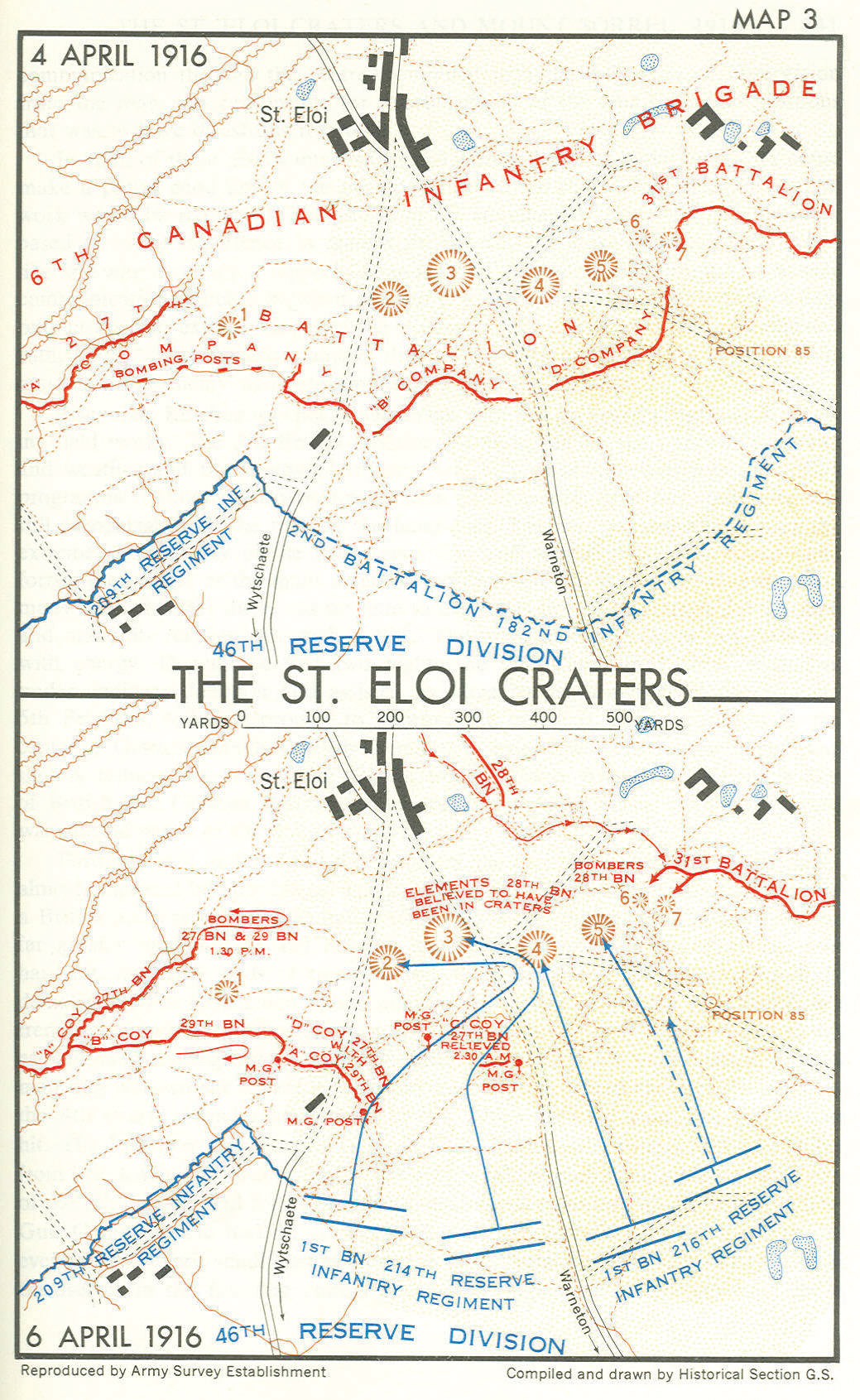
The top map shows the Canadian positions on April 4, 1916. The bottom map shows the Canadian positions at the time of the German attack on April 6, 1916.
The Germans disappeared from the sight of the 27th and 29th, making their way toward the craters.
One obstacle stood in the German path. A Lewis gun, manned by a team that was commanded by Lieutenant Browne of the 22nd French Canadians. His crew, seeing the Germans coming in force, didn’t run. They went to work, pouring fire into the attacking Germans.
Men of the 31st listened, hearing the bark of the Lewis gun. Then it stopped. Browne and his team were silenced after the men of the 31st heard one more lonely rifle crack. The Canadian lines were torn wide open, and the Germans were flowing through, heading for Craters 2 and 3.
To bolster the Canadian lines, a few groups of the 28th Battalion, the last unused unit of the 6th Brigade, were sent into the craters, but they were quickly overpowered by the Germans. The Canadian right flank could no longer help, so the initiative fell to the 31st on the left.
The Germans dug in around the craters, sending others on toward Craters 4 and 5. This would have put them to the rear of the 31st, but the German early morning bombardment actually worked to their disadvantage.
The 31st failed to endure the early morning bombardment, abandoning their original positions. Some of their units occupied Craters 6 and 7, while others fell back to the rearward lines, putting them in the perfect position to counterattack.
The men of the 31st, holding Craters 6 and 7, saw the Germans rushing for them and opened fire, holding on while Major Doughty of the 31st Battalion organized a defense. He took his men forward, bringing enfilade fire from all directions, taking the German attack head-on.
The rest of the morning was a scene of mayhem. Canadian units maneuvered, trying their best from both flanks to meet the German attack. The Germans did not give in. Seeing the Canadian units working their way to oust the attackers, they returned fire, working to wear down the Canadians.
In the end, the Canadians didn’t relent. They held on, but it was costly. The lines they spent days trying to hold, suffering in that cold, water-logged mud, were lost. Only the old lines, the ones closer to St. Eloi, held. The entire debacle that was the St. Eloi operation was a meaningless waste for the British-Canadian forces who wasted away in the mud and destruction that surrounded them.
St. Eloi: The Disaster
The St. Eloi battlefield claimed many British and Canadian casualties. The Canadian 6th Brigade paid a very heavy price, taking over six-hundred casualties out of an average battalion size number one-thousand.
The operations around St. Eloi exemplify World War I’s futile and pointless military doctrine. The total aversion to giving up an inch of ground, regardless of the cost, drove the machine that needlessly wasted so many lives during the brutal conflict.
From a historical perspective, we have to ask: why did things fall apart at St. Eloi?
When the British successfully destroyed the German trenches using their subterranean mines, they didn’t account for the damage they were about to do. For months, the Germans held the high ground around St. Eloi. As the Germans were known to do, they installed a solid series of trenches along the Mound and the surrounding area, to hold on to it for the duration of the war.
Had the British attacked the German trenches head-on, they would have rushed into a scenario that was all too familiar for World War I soldiers, going on the offensive. It would mean running head on, attacking the high ground, under the watchful eyes of German defenders manning machine-guns and pre-sighted artillery. It’s understandable why demolishing the German trenches seemed like a sensible strategy.
World War I offensives, taking place against entrenched enemies, had the advantage of capturing pre-built fortifications in the rare instance of a successful capture. The St. Eloi plan only ensured they would have no trenches to capture and make their own.
The British familiarity with the Ypres-Flanders region of the Western Front has been cemented into the history of World War I. It was a place that was perpetually wet, muddy, and miserable. The decision to blow the German trenches, hoping they would capture the ground and dig in, defied the logic of their WWI experience. How would it work?
Well, it didn’t.
The British who held onto the area around the craters for the week prior to the Canadian relief struggled to establish a foothold. They were fighting close to the German trenches. The previous German occupants had knowledge of the ground, the coordinates needed to blast the British and Canadian soldiers out of the area, while also having the advantage of a line of sight, aimed directly at the obliterated ground.
The desperate need for Canadian relief should have been a sign that the upcoming efforts, taken on by a rookie Canadian Brigade, would fail. British soldiers needing relief, because they couldn’t make any headway building their own defenses around the St. Eloi craters. The Germans were constantly infiltrating their lines, while they also pounded the area with endless artillery and mortar attacks.
How would the Canadians fare any better?
When the British led the green Canadian soldiers over this ground, that they had already occupied for a week before the 6th Brigade took over, they couldn’t even find their way over the terrain. When the Canadians found the lines they were to hold, they didn’t find trenches. They found water-filled ditches, shell craters, and foxholes that would have to serve as protection for the impending German artillery that was bound to pick up once the new Canadian reinforcements moved into the line.
The first few days of 6th Brigade occupancy were unproductive, to say the least. They couldn’t dig any trenches, establish communications, connect their lines, or withstand the onslaught of artillery. Holes in the line were so big that the Germans were able to rush a sizeable force through a gap in the lines, slipping into the craters that swallowed up the ground that was once home to their trenches.
The St. Eloi operations were a baptism of fire for the 6th Brigade, welcoming them to the realities of World War I. The Canadians, despite the loss of their forward trenches, performed admirably. As the Germans counterattacked, pushing the Canadians back, they clung on, fighting the Germans at close range, carrying on despite total exhaustion and the traumatic experience of their first days on the line. They bravely fought the German so closely that they called artillery down on their own heads. All the while, they fought on with guns that were jammed up with mud, sometimes encountering the veteran German attackers in moments of brutal, hand-to-hand combat.
The St. Eloi story in an important one for me. My Great-Grandfather saw his first action there. He was hit by shrapnel and left with traumatic, psychological injuries that left him hospitalized for months. He was forced to cling to the cold mud, clawing at the ground with his fingernails, digging himself a cover in any way he could. All around him the world exploded. His friends were killed or maimed. The violent vibrations of artillery explosions jarred him, shaking his body and his soul.
After all that, just a few months later, after spending months unable to speak in various hospitals, he rejoined the 27th Battalion on the front lines. He fought with them, until the Battle of Vimy Ridge, April 9-12, 1917, where a German machine-gun round through his knee ended his war, leaving him with permanent damage requiring a cane to walk for the rest of his life.
The story of St. Eloi is a representation of the unimaginable experiences that were lived by the soldiers who served in World War I.
Thank you For Reading
History on a Whim is here to instill a love for history, educate readers on how to conduct research, grow a base of knowledge, and to guide readers through the process of historical thinking and problem solving.
If you would like to get my articles, research notes, and history sources guides right to your inbox, please consider becoming a free subscriber on Substack. You can support me by becoming a paid subscriber, or consider giving a one-time donation, here.