
The History Finder Newsletter 6/6/26: WWII american Aviation
WWII American Aviation is the focus of this week’s newsletter.
I was inspired by a subscriber to do a little digging here, and this is what I came up with. It’s a long one, but I hope you enjoy it! Hopefully, it sends you down the rabbit hole.
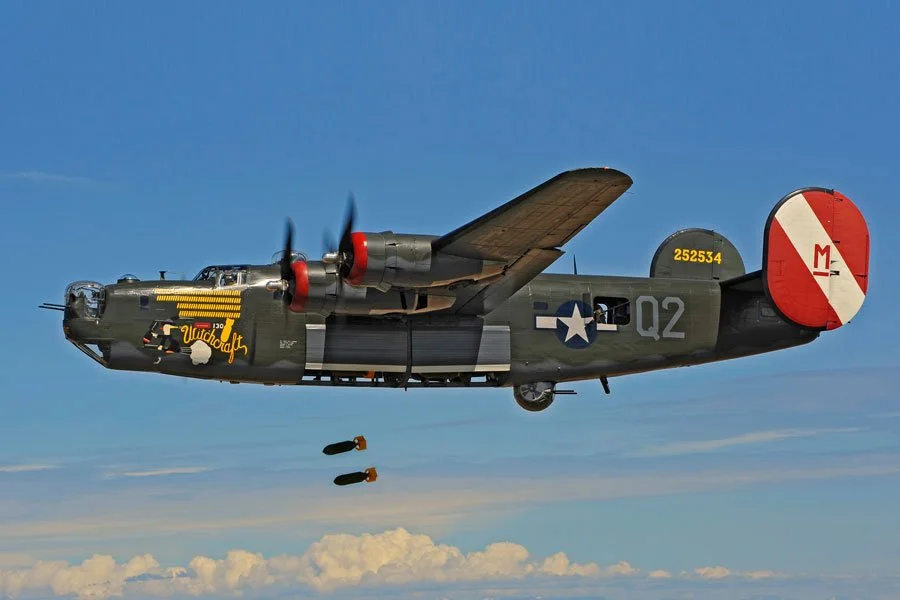
The Collings Foundation Consolidated B-24J Liberator. Image from the Collings Foundation.
Lewis Brereton Diaries
Lieutenant General Lewis H. Brereton was one of WWII’s most consequential air forces commanders. His time with the top brass during WWII in the Army Air Forces gives a unique perspective.
Why?
Brereton held a sweeping command during the war, starting with MacArthur in the Philippines, and he then ended up in the China-Burma-India Theater, the Middle East, and Europe.
Brereton held command over:
Far East Air Force: October 1941-January 1942. He was handpicked by Douglas MacArthur to command the building air forces in the Philippines as anticipation built for war. His command oversaw the disastrous collapse of the novice air force.
5th Air Force: January -February 1942. Escaping the Philippines, he took command as deputy commander for the combined American-British-Dutch-Australian (ABDACOM) air forces in Java to slow the Japanese advance.
10th Air Force: March- June 1942. Brereton was then sent to India to organize the 10th Air Force, the main numbered air force to serve in the China-Burma-India theater, with a heavy focus on bomber offensives.
9th Air Force: June 1942-August 1944. After leaving the 10th, he went on to Egypt, commanding the Middle East Air Forces (which became the 9th). The 9th was relocated to Europe, supporting the Normandy invasion.
First Allied Airborne Army: August 1944-May 1945. This organization was created to oversee all major Allied operations for the later stages of the war.
Brereton’s role in the development of joint tactical air-to-ground operations and airborne doctrine can’t be downplayed. You can get into the head of one of the Air Force’s top commanders by reading his published diaries here.
Army Air Forces in WWII: Official History
Just like all military branches during WWII, the United States Army Air Forces created an official history, a seven-volume set of books, covering the duration of the war. In the pre-digital age, when archival, physical records were the only primary sources available, the official historians for US military branches had access to all available records from the war. The books were started in the 1950s with the war still a recent memory, and they stand as a definitive history of the American air war of WWII.
The books are split up into seven volumes. Three cover the air war in Europe, with two covering the Pacific War. The sixth encompasses the recruitment, training, and performance of the airmen themselves, with a seventh looking into the various air services that were integral to the war, both on the ground and in the air.
As history like this should be, the books aren’t just a glorification of their grand victory in WWII. The books also exist as a way to remind us of what went wrong, how the air forces learned from their mistakes, and how to better prepare for future wars.
You can read all these books, completely free, here. If you click on the link (which you should!), the seven books are under the heading Army Air Forces in World War II. Anyone who is looking to write about this topic or conduct research should use these books as a basis for whatever they’re doing. From there, branch out, look into primary sources, or secondary sources, which offer analysis of the books, or new perspectives.
United States Strategic Bombing Survey: Pacific War
This survey was published in 1946 as a civilian and expert-driven study, analyzing the effect of the bombing campaigns against Japan. Like many post-war studies, they were used to determine the effects of the campaign for future warfare planning and to determine the contribution that the bombing campaigns made towards Japan’s collapse in WWII.
Studies like this are great, not just for their quantitative analysis, but as a way to approach military history. If you read my recent article “How to Read like a Historian,” I referred to the importance of the why question. Why, when studying history, stands on top as the most important type of question to ask. This is a perfect example of the “why” question at work.
Some question examples? “Why was the air war a contributing factor in Japan’s downfall, and what did they do wrong to ensure their eventual defeat?” or “Why was the air war against Japan an effective way of defeating the empire?” You can get even more specific: “Why did the United States decide to conduct the air war in the way that they did?” or “Why did Japan fail to prepare properly for the war they were trying to fight?
You can certainly ask other forms of questions, but the why should be your basis. Ask your why questions, then use some other types to answer that question. “What did the United States do that differed from the Japanese?”
Just some examples, but this book gives you some great “why” question answers that you can use in future writing or research.
Check out the book here for free!
The United States Strategic Bombing Surveys: Europe
On the flip side of the above book, the USSBS: Europe is focused on the same analysis, but focuses on the bombing campaigns in Europe. What questions can you think of while reading this? Try to make active reading and questioning the basis for reading this report.
You can read it here. This one is both the European and Pacific Surveys in one volume, offered by the Air University, a university affiliated with the US Air Force.
US Naval Aviation in the Pacific
When we’re talking about the American air war of WWII, it’s not all about the US Army Air Forces. We can’t leave out the Naval and Marine aviators who crushed the Imperial Japanese forces during WWII. One earlier work, United States Naval Aviation in the Pacific, focused on the efficiency and tenacity of America’s Pacific War air war efforts.
This account was published immediately after the war, in 1947, by the Office of the Chief of Naval Operations to analyze the effectiveness of carrier and land-based air elements in bringing about the Japanese defeat.
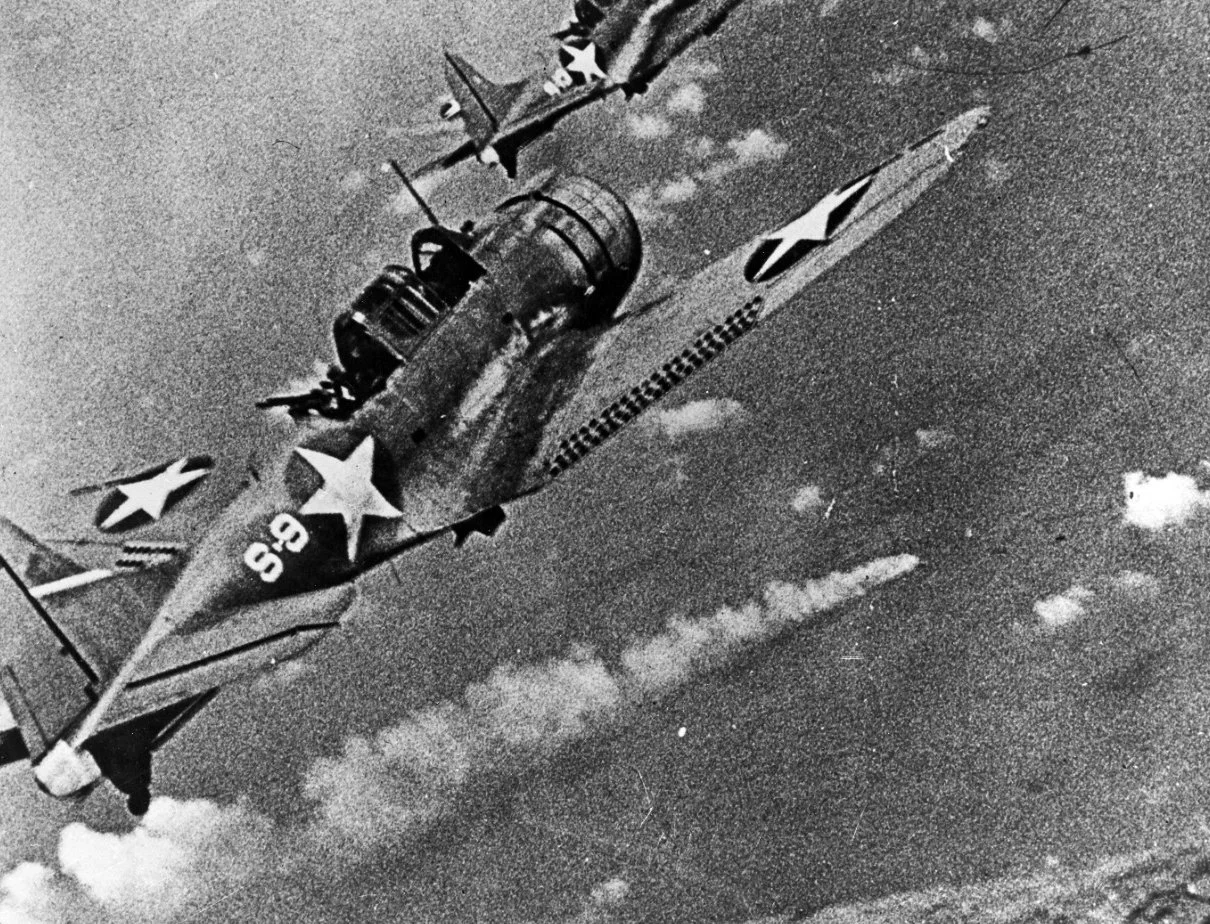
Naval and Marine Aviators played a crucial role in bringing down the Empire of Japan. Japan’s naval might was brought to its knees due to the efforts of airmen in the Pacific.
Marine Corps Aviators during WWII
We can’t forget about the lesser-known Marine Corps airmen who served in WWII. They tend to get overlooked when held up against the grand bombing campaigns of the European theater, or the Naval campaigns like Midway, Leyte Gulf, and the Philippine Sea. Those elements have been enshrined in the popular imagination surrounding WWII. Marine Corps pilots were integral in supporting the US Naval operations in the Pacific during WWII.
Pre-war, the USMC pilots were expected to serve as close air support for Marines on the ground, but the war necessitated a change. Before the war, these pilots were part of a vision, one where they would serve as both ground attack elements and a secondary cadre of planes for US Navy Carriers. The sudden onset of war and the need for a force buildup led to the removal of carrier qualification requirements.
During the war, the Marine airmen were rarely used to support ground operations. Instead, they became short-ranged Naval support elements, attacking shipping and fighting for air superiority. They became the Navy’s land-based element of fleet aviation. They were occasionally used to support ground operations, being used in 5 out of the Marine Corps 12 major landings during WWII.
Here are a few free books published about WWII’s Marine Corps Aviators.
*Marines at Midway* by Lt. Col. Robert D. Heinl, USMC, 1948. Published by the Historical Section, Division of Public Information, HQ, USMC.
*Marine Aviation in the Philippines* by Major Charles W. Boggs Jr. USMC, 1951. Published by the Historical Division, USMC.
Check out the USMC Squadron Series published by the History and Museums Division HQ, USMC. This is an Internet Archive Search link, so to read them, you might need to sign up for a free account (which anyone doing historical research needs to do!)
If you are looking for any more books on the USMC and WWII, check out the United States Marine Corps History Division and their list of publications. You can read all of these as a PDF.
More Sources to Check out:
Department of the Air Force Legacy Vault:
The DAF Legacy Vault is the home for dozens of books published on behalf of the United States Air Force. This goes all the way back to the beginning, to the turn of the 19th century, and includes books about units, individuals, and campaigns.
Check out the publications here. All are available via PDF; just use the website to browse, click on a book, and start reading.
World War II Diaries of Henry “Hap” Arnold:
HAP Arnold was the commanding general of the United States Army Air Forces during WWII. His two-part published diary is available to read on the U.S. Air Force University website.
Tips for researchers:
The internet is a vast universe where you can get lost clicking next on limitless search results pages. Knowing what you’re searching for is best if you can focus in on details. Since this newsletter is dedicated to the Air War of WWII, you should search for:
Individuals
Numbered Air Forces: (Eighth, Seventh, Tenth, etc.) I have another tip here for you as well. Numbered Air Forces were usually described by writing out the number rather than just using the numerical value. For example, use the Fifth Air Force instead of the 5th Air Force. If you look at the numbered air force’s insignias, the written number is usually scrawled across the bottom.
Wing Number
Group Number
Squadron Number
Flight Number
This is how WWII Units were broken down for the US Army Air Forces during WWII.
Numbered Air Force< Command: Made up of Wings< Wing: Made up of 2-4 Groups< Group: Made up of 2-3 Squadrons <Squadron: Made up of 12-24 Aircraft < Flight: Made up of 3-6 Aircraft. Groups can be designated as “Bombardment” or “Fighter” groups. Bombardment groups can be very heavy (usually B-29), heavy, or medium bombers.
Breakdown for U.S. Naval Units during WWII:
Carrier Group Number (CVG): 3-5 Squadrons< Squadron: 18-36 Aircraft< Division: 4 Aircraft< Section: 2 Aircraft
Don’t hesitate to use bibliographies
I know I probably bring this up too much, but it’s because the point can’t be overstated! Look at secondary sources like books, articles, or blogs, even to see what sources they cite. Do an internet search for the sources listed to see if you can find any online. Or, if you can make a trip to those archives, check it out! Many archives will send you digital copies or let you borrow microfilm reels through an inter-library loan, but that’s not always free.
Keep a running list of sources! I’ve been a fan of using Notion as a way to keep track of everything. It’s how I organize all my research, content, sources, etc. You can access your Notion dashboard from any browser. I keep the app on my phone. That way, if I run into any new sources, I immediately log them, or if I have any new insights or notes to record, I have a way to record them wherever I go. Just a thought. You can use Google Docs, Word Docs, Excel Spreadsheets, Google Sheets, Google Keep, Obsidian, or anything else you feel comfortable with. Just don’t lose your sources! As someone who has been doing this for a long time, keeping your sources organized will save you a lot of future frustration.
That’s all I have for this week.
Of course, this newsletter comes out on June 6! Instead of focusing on D-Day, I looked into WWII aviation, but that’s because I’d planned for an earlier release.
I will be putting out more, shorter articles during the week.
Earlier in the week, I wrote an article titled “How to Read Like a Historian: A Guide,” which you can read here.
For more information about historical resources, check out my website www.historyonawhim.com. I’m working endless hours to get the site updated and organized for easier use!
If you know anyone who has a passion for history, research, or just loves digging around for cool sites and info, please pass this along.
My entire mission in life is to get people excited about history, no matter what their area of interest is. I want to bring people the resources they need to dig deep and do their own research, not just using surface-level articles or AI summaries to inform their knowledge.
So, once again, please pass this along. If you’re not already a Substack subscriber, please sign up, and you’ll get this sent to your inbox. Consider becoming a paid subscriber to help the mission along. Or, you can give a one-time donation to help out the cause.
Until next time!
I have to give a huge thank you to my subscribers! Thanks for helping me grow and keep the mission going. We need people who can conduct historical research in a time when many are too reliant on machines to think for them!
To my paid subscribers, I can’t convey how grateful I am that you are willing to support the mission here! Teaching people, giving them the tools they need to research, and making history important again is my life’s mission, and you’re making it possible!