
The History Finder 5/27/2026
It’s been a few weeks since I’ve put out a History Finder Newsletter. I’ve been busy working on some other stuff, but that doesn’t mean I’ve been slacking on my search for new sources. In fact, I’ve found so many I have to choose what to throw onto this newsletter!
I’m adamantly working on updating my online resources pages on www.historyonawhim.com. This means organizing, categorizing, and finding new resources every day. My Notion database of sources is growing beyond anything near manageable these days, but I will commit fully to putting all of these on the site!
You need to create a WorldCat account!
What is WorldCat? WorldCat is the largest library catalog in the world. The site is a collaborative effort between libraries around the world to make their collections more accessible. It’s also one of the best ways to find any resource or search for sources pertaining to any topic you’re researching.
If you make yourself an account, you can create your own lists of resources. You can also favorite certain libraries, and any time they update their collections or add to them, you will get an update.
If you make an account, you can create your own lists based on whatever topic you’re researching and organize them that way for easier recall later.
You might hear “library” and think only books, but it applies to digital collections, archived resources, etc. Many of the things you search for will be digitized and accessible online. If you’re just trying to find the home for certain resources, or you just want to discover possibilities, this is the way to start.
Back when I was working on my Ph.D. and dissertation, sites like WorldCat were invaluable to my research. I could search names of people I was researching, or topics and WorldCat would point the way.
Many of their resources are available right there on the WorldCat site if they’re digitized.
Secondary to the WorldCat site, you can use ArchiveGrid. ArchiveGrid takes much of its data from WorldCat, but guides you towards archival materials and finding aids. This means documents, personal papers, family histories, museum collections, historical society holdings, and archival material.
If you want the ultimate shortcut to creating thorough source lists, this is the place to start.
As someone who loves this stuff, I can spend hours on there just getting lost in the world of historical resources.
One of the coolest sources I’ve found this week is the Ike Skelton Combined Arms Research Library- Digital Collections
The Ike Skelton Combined Arms Research Library (CARL) is a research center for the US Army’s Command and General Staff College. The Command and General Staff College (CGSC) is a graduate school for US Army officers who usually enter the school mid-career for a chance to become a more capable commander or hold an Army staff position.
Graduates of the CGSC receive a Master of Military Art and Science Degree after they complete a thesis. The school provides thorough digital resources so its prospective graduates can complete their research. That usually means military history research, which is what I like to hear.
The digital resources that are accessible to anyone include primary source documents, unit military histories, research papers, and books. It’s conveniently categorized!
This includes databases on every major American conflict from the Civil War onward. The World War II Operational Documents database is filled with operational orders, reports, photographs, and a huge collection of WWII maps. The maps are digitized copies of maps used during the conflict. Enjoy going down that rabbit hole.
One of the most historically fulfilling aspects of the CARL website are their freely-accessible publications. Visitors to the site can read the approved theses of Staff College grads, student papers, and published military journals. Many of the publications you’ll find on the CARL site are history-focused, and they are considered peer-reviewed, so they are authoritative sources. I find that reading theses and other publications is a great way to find new perspectives on historical topics, because most graduate theses are based on original research or topics.
So, (I’m talking publications here) check out:
US Army Combined Arms Center Repository (works produced by staffs and organizations assigned to the ASACAC)
Papers of the Combat Studies Institute
*Military Review* a peer-reviewed journal on the art and science of land warfare and anything else of interest to the US Army and Dept. of Defense.
This is just the tip of the CARL iceberg, but you can find (what feels like) never-ending sources to absorb like a historian-shaped sponge.
WWII Army Newspapers always fascinate me.
Not just WWII Newspapers, but any newspaper printed for the troops. It’s a remarkable way to understand the way the army and government officials sold the war to the men and women who were serving.
Every war subjects the soldiers who are fighting to propaganda. How else can you get many soldiers to do the things they have to do? If you don’t vilify the enemy and promote your own cause, then how can you get the soldiers to buy in?
Think of the American Civil War. In 1860, although tensions were high across the country, everyone who fought in the Civil War for either side was an American. A few years later, these men were killing each other in America’s bloodiest conflict. It wasn’t just firing at each other across an open field. The Civil War was brutal and often devolved into hand-to-hand fighting. How do you get someone to do that?
You have to sell the war to those fighting in it. Men who lived in deplorable conditions, volunteering to give up their civilian lives, to kill or be killed. That required a concerted effort for both sides of the war to justify the cause, inspiring the soldiers to fight.
Army Talks was a WWII publication for those fighting in the European Theater of Operations. The newsletter, or pamphlet (whatever you want to call it), was published to keep soldiers informed of wartime and political events, boost morale, and make the readers better soldiers.
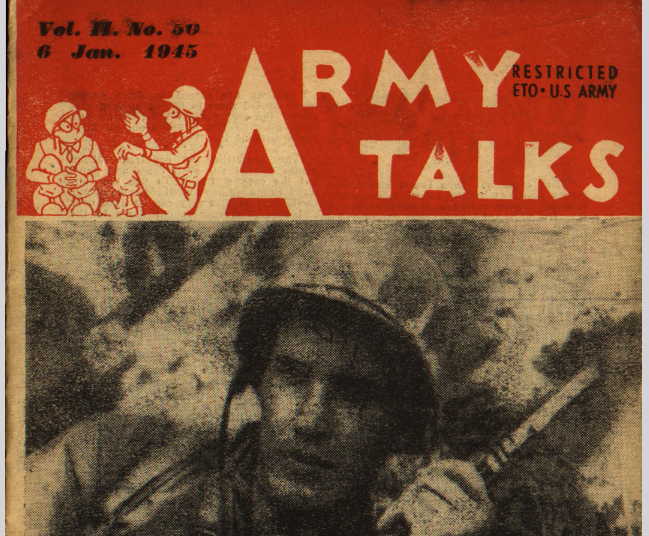
The January 1945 issue of Army Talks
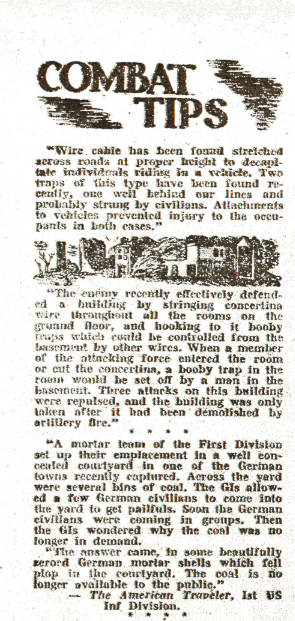
The Pamphlet included tips for men fighting on the frontlines.
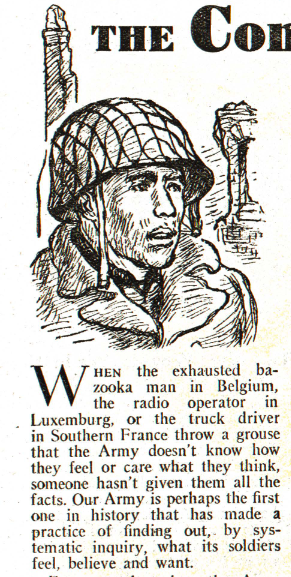
And, it included plenty of “morale boosting” articles, like this one here. “No army in history has cared more for its troops than this one!” (I’m paraphrasing).
Much of the pamphlet is committed to various talking points surrounding the war and geopolitics. It usually consisted of opinions or statements from fighting men on topics like “Will Germany Try a Come-Back After the War?” “How Do You Feel About German Prisoners?,” followed by some news snippets.
Seventy-one issues of Army Talks are available here, on the University of Richmond Digital Collections site.
The pamphlets are short, as they were meant to fit in a soldier’s pocket, so you can get through them pretty quickly.
Army Talks is just one example of the military newspapers printed throughout history’s wars. You can use them to get a better feel of the way troops were treated, or expected to think, and give you an understanding of the things that concerned wartime officials.
Like any historical topic, you can look at this from many different angles. Get creative, ask questions! Studying history is asking lots of questions and using the sources to help us form an opinion. What questions come to mind when looking at this?
How were fighting men treated by the officials who published this pamphlet?
What were officials concerned with?
Would this information have mattered if you were fighting in the front lines?
What does history say about the opinions in these magazines?
How do they compare to publications from other wars?
Were these magazines concerned with propagandizing soldiers?
Were the things told to the soldiers, in these magazines, true?
That’s just scratching the surface, but if you want to write about, or research certain topics, you can come up with endless angles just from a few sources.
Just a quick aside- Check out university libraries!
I’m sure I’ve said this plenty of times over the years, but every university, college, etc., has a website for their libraries, or archives. Use this to find new sources!
In our modern internet age, schools and libraries have been putting in the work to digitize their collections. Each school focuses on different topics for their digital collections, so it’s a great way to find nuance.
They will often cover larger topics (The Civil War, World War II, Gilded Age, etc) but also have wonderful smaller collections that came from individuals, or are based on narrower subjects (Virginia in the Civil War, Italy in WWII, etc.)
Knowing this, just throw a dart out there and pick a random school, see what you come up with. As a military historian, I will search things like “Civil War University Archives” or “World War I university digital collections,” just to see what pops up. Modern search engines, especially with AI at the forefront, let you ask direct questions like “what university archives have digital collections focused on the Civil War?” Just take a chance, see what collections your local college or university has to offer.
Universities offer extensive research guides, finding aids, and resource lists on various topics. If you’re looking into a major historical event, it doesn’t matter what country you live in; your universities will have resource lists of their own for the topic you’re researching.
That’s it for now!
I’m working overtime to get all my resources updated on www.historyonawhim.com including the ones I listed above. The site may look messy for now, but a more organized and topic-focused set up is coming!
I’ve also been creating my book reading lists for many military and general history topics. Right now the site has one on the War in the Pacific-WWII, but I’m working to get several more up.
If you know anyone who has a passion for history, research, or just loves digging around for cool sites and info, please pass this along.
My entire mission in life is to get people excited about history, no matter what their area of interest is. I want to bring people the resources they need to dig deep and do their own research, not just using surface-level articles, or AI summaries to inform their knowledge.
So, once again, please pass this along. If you’re not already a Substack subscriber, please sign up, and you’ll get this sent to your inbox. Consider becoming a paid subscriber to help the mission along. Or, you can give a one-time donation to help out the cause.
Until next time!